Does a pathology second opinion need the report, the slides or both?
Understanding an existing report and asking another pathologist to examine material are different requests. Confirm the review scope and receiving laboratory's requirements before arranging a transfer.
First clarify what is being reviewed
Do not assume that uploading a report arranges another examination of the tissue material. Ask whether the service will help explain an existing report, reconsider clinical recommendations using available records, or arrange a pathology-material review by another pathologist. Those requests can require different preparation.
This article concerns questions about surgical pathology in cancer care. It does not interpret a diagnosis, select tests or decide whether another review is needed. Discuss that decision and its timing with the treating clinician.
A map of the preparation question
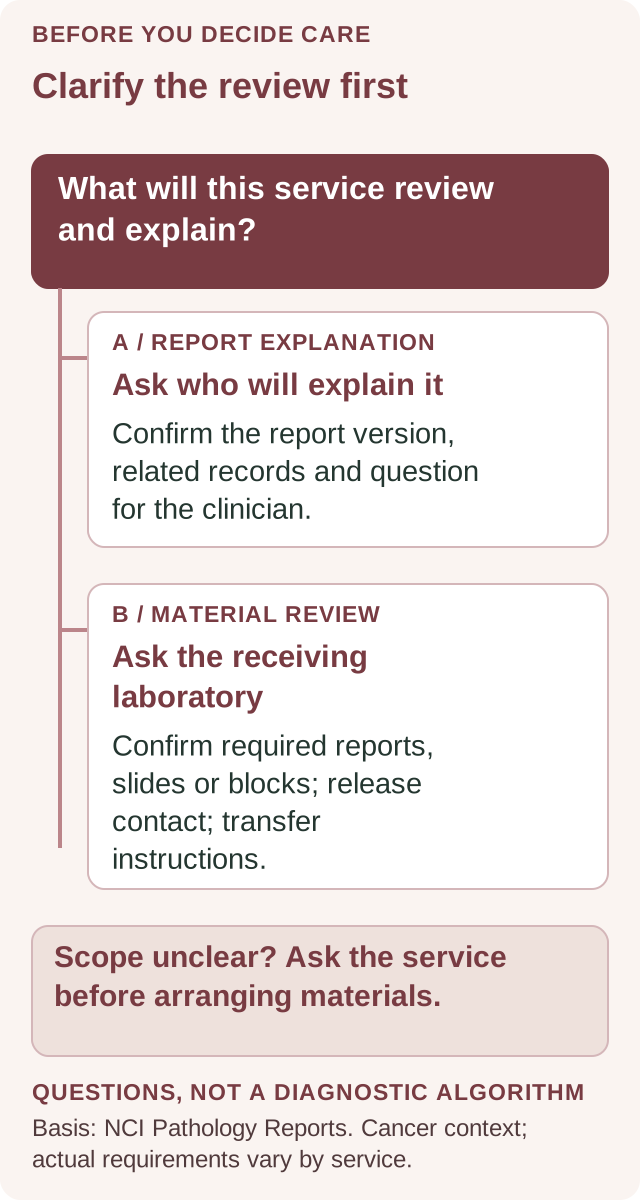
Figure: clarify the service before arranging materials. The branches are questions to ask, not diagnostic choices or mutually exclusive care pathways. A service may include more than one task. This original diagram draws on the National Cancer Institute's Pathology Reports guidance, reviewed 8 August 2022. It does not establish requirements for every laboratory.
If the aim is to understand an existing report
The NCI says the treating doctor can explain the pathology findings and what they mean for the patient's situation; patients may also ask to discuss the report with the pathologist.
Make the question precise: is a term unclear, is another result still pending, or is the question about how the report informs the treatment discussion? Ask the service which version of the report and which related records it needs. Keep the request for an explanation separate from a request to re-examine pathology material.
An explanation is useful even when it does not produce a new pathology report. Conversely, a new appointment or booking receipt does not establish that another pathologist has examined the material.
If another pathologist will examine material
For a second opinion on surgical pathology results, the NCI describes obtaining slides and/or a paraffin block from the original pathologist or the hospital where the procedure took place. It advises contacting the receiving facility in advance about availability, cost and shipping instructions.
Before arranging anything, ask the receiving laboratory:
- What exactly will you review, and which report and accompanying information do you require?
- Do you need slides, blocks, a particular set of material or an accepted digital format? Who will confirm that the supplied material is sufficient?
- Who should request release from the original institution, and where should the institutions send their questions?
- What charges apply to the agreed review? How will missing material or extra work be discussed?
- Who will explain the findings, and how will the report reach the treating clinician?
These are preparation questions, not instructions to obtain, package or transport specimens yourself. Follow the institutions' actual instructions. Any cross-border transfer needs its own checks; this article does not establish import, export or courier requirements.
Keep the stages distinct
Use a short status note: requested → received → sufficient for the agreed review → report available. Ask the service who confirms each stage. These are suggested administrative labels, not a universal laboratory workflow or a turnaround promise.
If material will be returned or retained, ask the institutions to explain the arrangement and who follows up on it. Do not assume that receiving the report means all material has already been returned.
For the separate conversation about what the resulting opinion does and does not answer, use the written-second-opinion question sheet.
Sources checked on 23 October 2026. No patient case or laboratory performance claim is used here. A preparation checklist cannot determine the correct diagnosis or whether a review will change a recommendation.
Sources
Take these questions to your clinician. The options guide can help you organise a discussion about benefits, uncertainties and alternatives.